

Sauna After, Cold Plunge Before: Dr. Kirk Parsley on Recovery

Brian Cain at his Thermory Square #40. Photo: Brian Cain.
Brian Cain asked former Navy SEAL and physician Dr. Kirk Parsley how to use the sauna and the cold plunge around training. The short answer: sauna after, cold plunge before.
How hot? How long? And does the cold plunge go before the workout or after it? If you train hard and there’s a sauna in your backyard (or one on the way), those answers decide whether it helps you or just wears you out.
Brian Cain put those questions to Dr. Kirk Parsley on the Mental Performance Mastery Podcast. Brian is a mental performance coach who works with athletes. Dr. Parsley is a former Navy SEAL and a physician. Brian’s sauna came from us, so we listened closely. Here’s what’s worth taking into your own routine.
The full episode, 32 minutes. The sauna and cold plunge talk runs to about the 21-minute mark. Watch on YouTube.
Start with what you want out of it
Dr. Parsley won’t hand out one protocol for everybody. What you did before the sauna changes the answer, and so does where you live; he compares a sauna in Arizona with one in a Wisconsin winter. So does the goal. Living longer, building cardiovascular fitness and recovering from training are different things, and he treats them that way.
What heat and cold share is your heart. In a cold plunge, the blood vessels in your skin and limbs tighten and push blood to your core, so your heart fills faster and pumps more with each beat. In the sauna, those vessels open, blood moves out toward your skin and your heart rate climbs. Opposite routes, and either way your heart moves more blood. He calls both exercise mimetics, because some of their benefits are similar to the benefits of exercise.

Dr. Kirk Parsley on how heat and cold each get your heart moving more blood. Video still: Brian Cain.
The sauna: about 20 minutes, right after training
His starting point for recovery is about 20 minutes in the sauna after a workout, right away or soon after. Stretch or talk with your friends first if you like, but don’t wait an hour. “Do it before you cool off,” he says.
Most people tell him they recover faster that way. He’s careful about what the research can prove, though: it’s easier to show that people feel better than to show they put on more muscle or do more work at the next session.
The heat should make those 20 minutes hard. Brian floated 180°F for 20 minutes. Dr. Parsley said 180 would be hard for most people to start with, and Brian admitted it has been for him: about 10 minutes, “and then I’m crawling out of that thing.” Dr. Parsley’s suggestion is to start around 160 to 165°F and turn it up when that gets easy. The target is challenging, not destroying you. You should come out glad to be out of there, and also glad you did it:
I actually feel good that I did it. Not, oh, I barely made it with my life.
Dr. Kirk Parsley
- Raise the heat before you add time. He’d hold around 20 minutes until you’re up near 200°F, and only then think about longer sessions, maybe 30 minutes over time.
- About five days a week. Heat is hard on your nervous system, and your nervous system is involved in your training too.
- Don’t measure yourself against someone’s post. Brian brought up Joe Rogan doing 20 minutes at 220°F. You adapt to heat, Dr. Parsley said, and you don’t know what they did first. After a cold plunge, you can usually sit at 200°F for 20 minutes and feel fine.
Holding the temperature you choose, session after session, is the heater’s job. Brian’s Square runs a 10.6 kW HUUM HIVE Mini, the largest of its three sizes, loaded with about 330 lb of stones. We picked the biggest one for him so the heat is there when he wants to push it. A Wi-Fi HUUM UKU control runs it from the HUUM app.

Brian beside his HUUM HIVE Mini, with its HIVE safety rail and a Saunapallo steam ball hanging next to it. Photo: Brian Cain.
· · ·
The cold plunge: before strength work, not right after
This is the one Dr. Parsley calls “pretty well settled.” A cold plunge right after your workout reduces the strength and muscle gains you were training for. The cold blunts the signals your muscles use to rebuild bigger and stronger. A 2015 study in The Journal of Physiology found the same pattern in a small group of active men: after 12 weeks of strength training, the ones who took a 10-minute cold water bath after each session gained less strength and muscle than the ones who did an active cool-down.
His fix is to move the plunge:
- Plunge before strength or power work. The jolt from the cold carries into the workout, he says. He keeps a hand grip tester around, and after a plunge his grip reads 15 to 20 pounds higher. He puts it down to adrenaline. It’s his own informal test, done here and there for about a year.
- Warm up after. A five-minute plunge around 40°F keeps your limbs, and probably your core, a little cooler for an hour or two. Ease into the session.
- Aerobic training is different. If you’re training for aerobic fitness, he says the timing doesn’t matter.
- Three to five minutes for most people, and don’t keep adding time, even when you feel like you can. If you’re only plunging to wake up, a minute does it.
Brian asked about the football teams that pile into cold tubs the minute practice ends. Dr. Parsley’s answer: that cuts into their muscle and strength gains, though it doesn’t interfere with their aerobic fitness and probably not with their skill work.

Dr. Kirk Parsley (left) and Brian Cain on the Mental Performance Mastery Podcast. Video still: Brian Cain.
His own week
When Dr. Parsley had a cold plunge at home, he used it two to three days a week and the sauna four to five, based on the kind of workouts he does. He’s clear it’s his personal routine. And the surprise: for him, the sauna is the harder one. He credits a past life spent diving in a lot of cold water. The plunge just doesn’t give him the adrenaline boost it gives a lot of people.
The short version
Brian closed the sauna and cold plunge part with a recap:
- Finish your workout, then about 20 minutes in the sauna at a heat that’s challenging but tolerable. Start around 165°F and work up as your tolerance builds.
- Keep the cold plunge away from the end of a strength or muscle-building session. Before the workout is fine: right before, or first thing in the morning.
- Three to five minutes in the cold.
- Training for aerobic fitness? Dr. Parsley says the plunge timing doesn’t matter.
None of this is a prescription for you. If you have a heart condition or high blood pressure, are pregnant, or take medication that changes how you handle heat or cold, talk to your doctor before you start.
The back third of the episode moves on to caffeine, sleep and consistency. It’s worth the listen if you’re dialing in a morning routine, especially the part about how one short night changes what your body does with the same meal.
· · ·
Brian’s sauna
Brian went with a Thermory Square #40, made in Estonia from Thermory wood: L-shaped upper benches, a glass front, two porch seats outside and the big rear window, which looks out over his backyard. Inside are the 10.6 kW HIVE Mini, the Wi-Fi UKU and the Saunapallo. Ben Frizzell still owns the first Thermory Square sent to North America and uses it nearly every day, so we know the Square and how to get the most out of it.
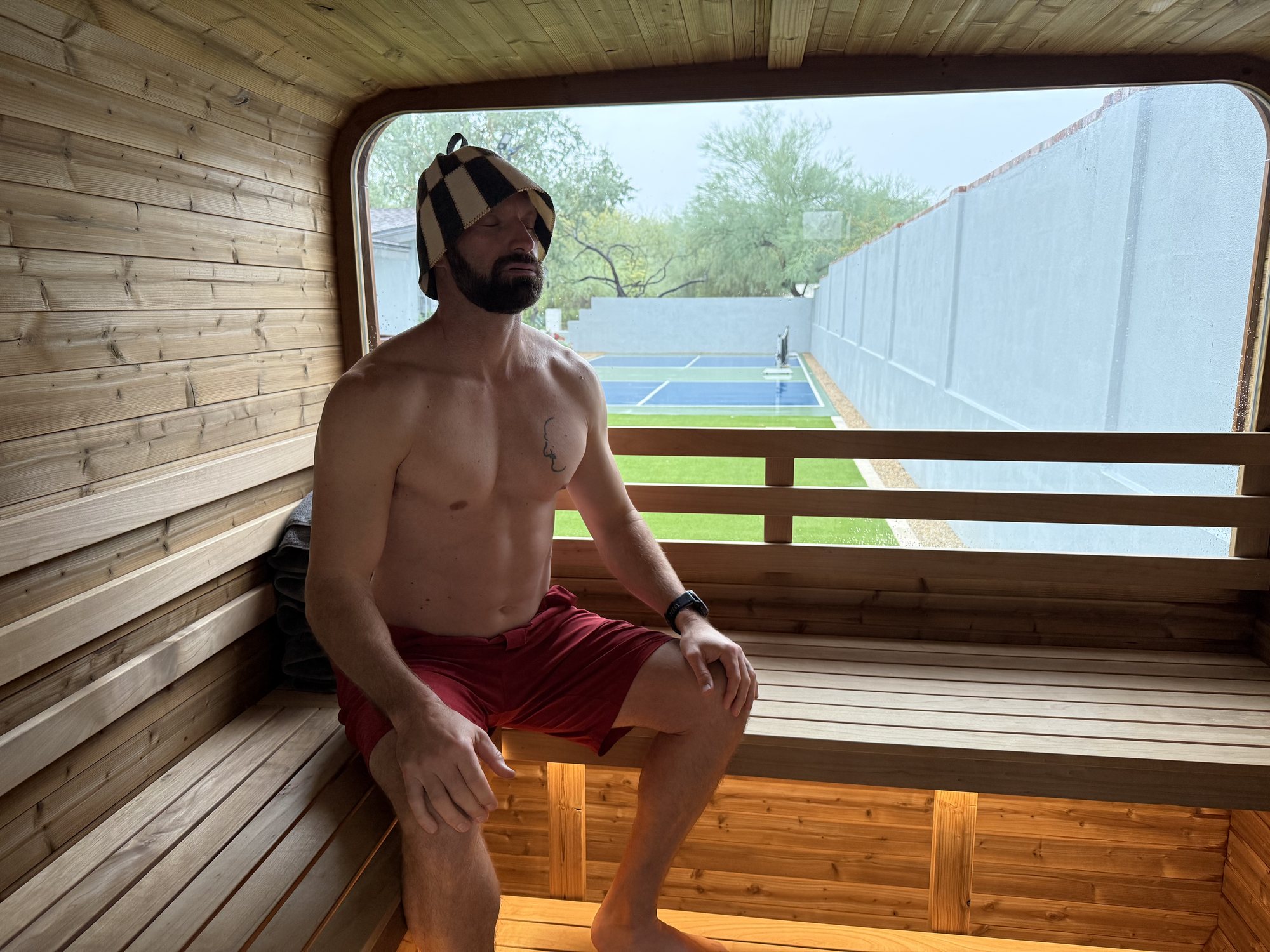
The rear window, from the L-shaped bench. Photo: Brian Cain.
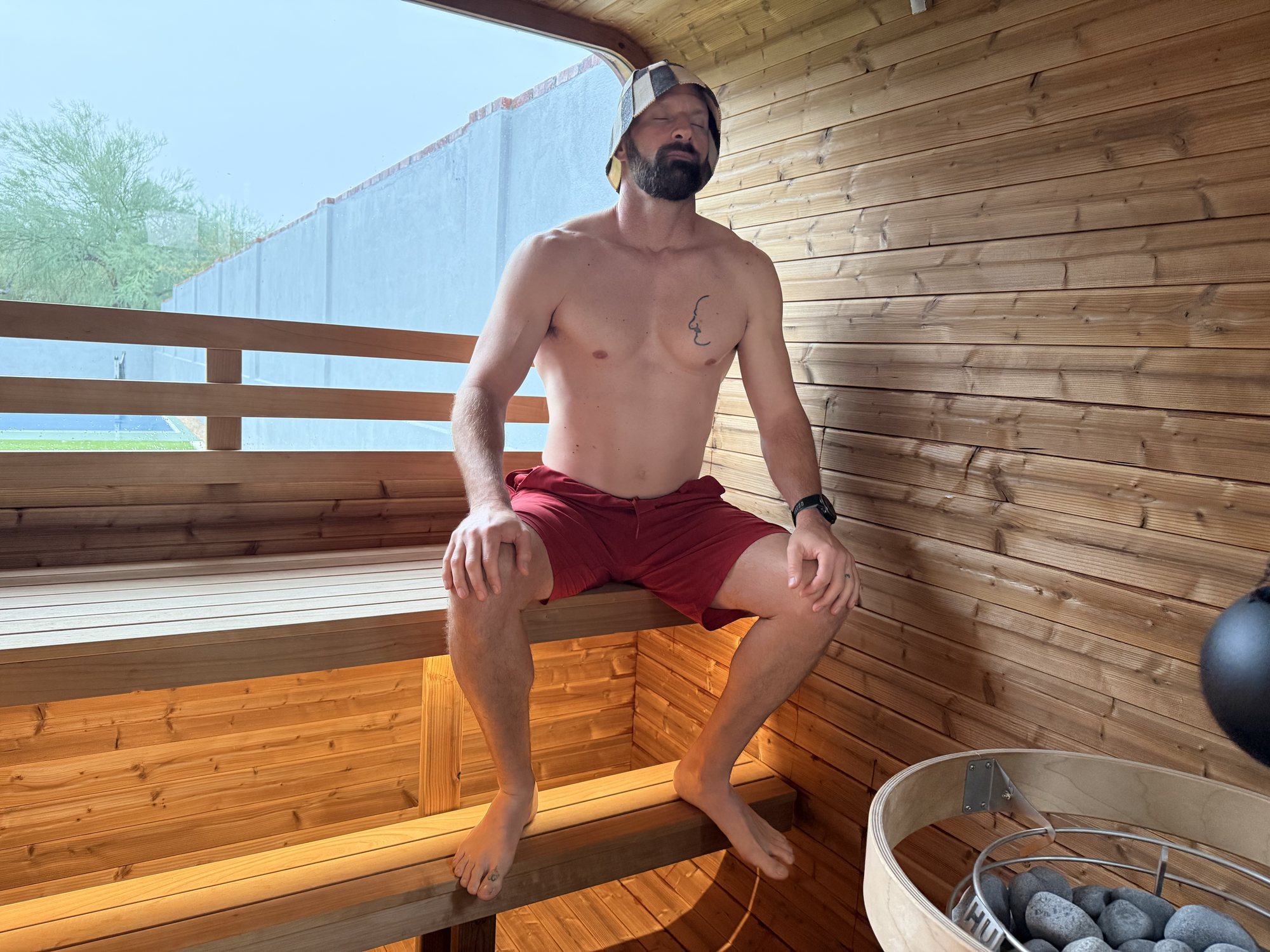
Upper bench, feet on the lower one, the HIVE Mini at the edge of the frame. Photo: Brian Cain.
Build a setup like Brian’s
Tell us where it’s going and how you train. We’ll match the sauna and the heater to it.
See the Thermory SquareWant to talk it through? Call us at (844) 565-1113, and if you found us through Brian’s show, tell us. Looking for the cold side too? Here are the cold plunges we carry.
 Prebuilt
 Brushes, Whisks and Body Care
 Vents